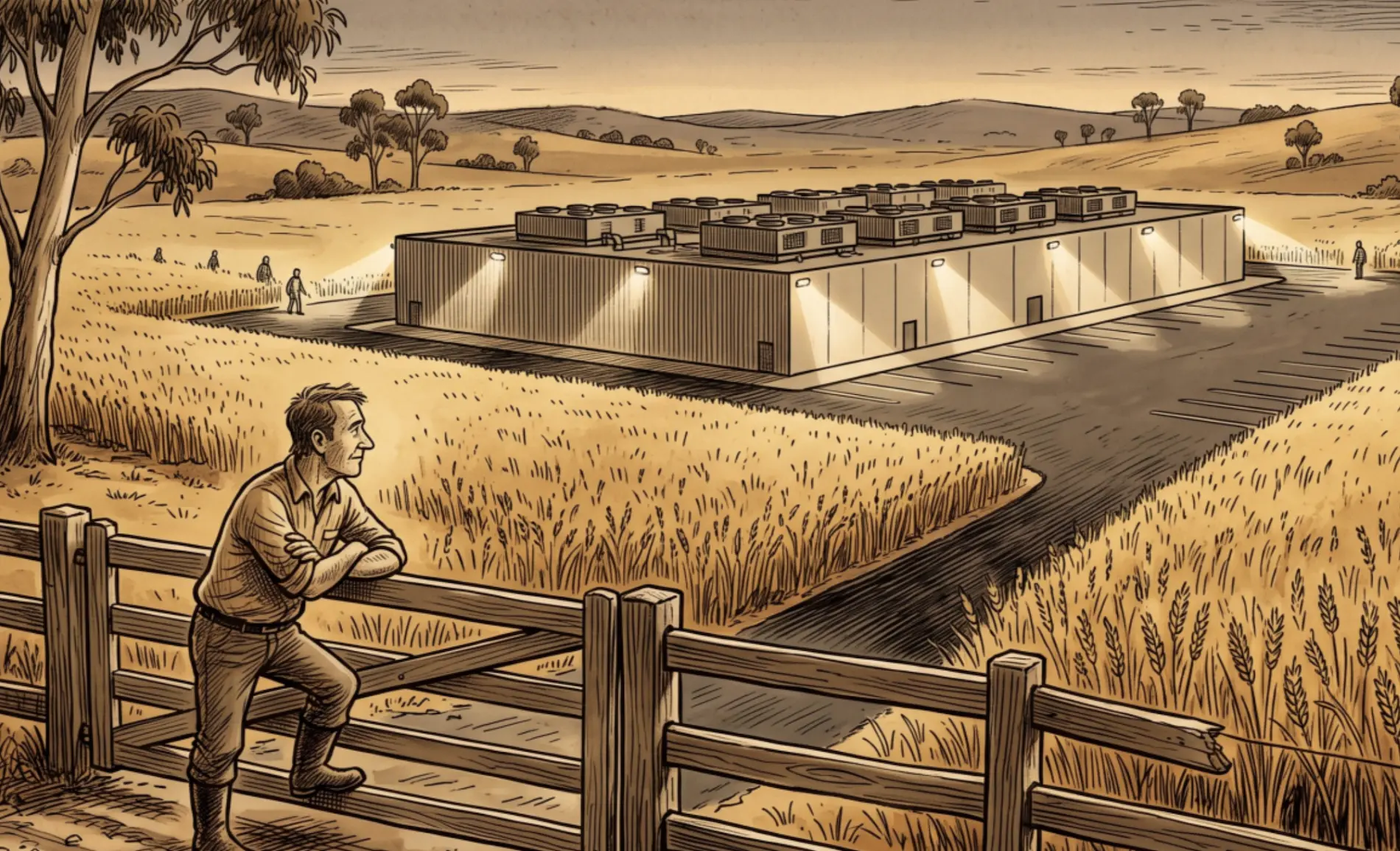

When the first third of Telstra was sold in 1997, the issue price valued the whole company at about $43.7 billion. When the first third of Telstra was sold in 1997, the issue price valued the whole company at about $43.7 billion. Firmus, which builds what it calls AI factories, has priced its float at $11 a share, valuing it at $43.7 billion. It is the biggest float since Telstra.
Telstra was the phone company, used by almost every Australian, most of them every day. It drew 1.8 million applications, and retail investors took 60 per cent of the offer. Adjusted for inflation it was about twice the size of Firmus, as Capital Brief has pointed out.
Firmus started in Launceston in 2019, testing its cooling systems on Bitcoin mining. Today it fills buildings with Nvidia chips for customers including Meta, OpenAI and Nvidia itself. About 85 per cent of its US$67.8 billion in signed contracts is tied to sites in Indonesia and Malaysia, and its existing big investors will take about half the shares on offer.
Firmus is the first phase of the AI build-out: the factory. Factories pay off when the things they make get used, and here that means organisations putting AI to work. Most of that is still ahead of us.
Dial-up
The telecommunications market opened to full competition in July 1997, a few months before the float. There was about one mobile service for every four Australians. By the following year, 16 per cent of households had the internet at home, mostly over dial-up. Google did not exist until September 1998, and the NBN was more than a decade further off.
That same year in Melbourne, two small teams started moving newspaper classifieds online. They became Seek and carsales. With realestate.com.au, which started in a Doncaster garage two years earlier, they took the newspapers' rivers of gold. Today dozens of retailers sell services over the NBN, a network the government built after selling Telstra. Much of what the network made valuable was built on top of it, often by companies that barely existed when Telstra floated.
Whatever your view of Firmus's price or prospects, this is a moment like that one. If 1997 is any guide, the constant is change, and most of it is impossible to see from the start.
Paid in advance
Bain & Company put a number on the second phase last week. By 2031, it estimates, the world could be spending about US$1.5 trillion a year on AI infrastructure, and AI would need to earn about US$6 trillion a year to justify it. The uses already in sight, from consumer subscriptions and advertising to enterprise software, might reach US$1.2 trillion to US$1.8 trillion. The other US$4.2 trillion would have to come from products and uses that do not exist yet.
Anthropic shows the same bet inside one company. Five years ago it had just raised its first round. According to a draft prospectus reviewed by Reuters, its revenue last year was US$4.6 billion. It has also committed about US$518 billion to computing over roughly the next decade, most of it payable whether it uses the capacity or not. Its float, expected in New York before the end of November, is being talked about at more than US$2 trillion.
Follow the chain. Factories like Firmus rent their capacity to labs and big technology companies. The labs are paid, in the end, by people and organisations using AI. Every dollar spent at the bottom is a bet on what happens at the top, and for most people reading this, the top is your organisation.
Putting it to work
Brian Hartzer, the former Westpac chief executive now at Quantium, argued in the AFR this week that the bigger prize from AI is growth. That means new products, and customers who used to cost too much to serve. Britain's fortune, he pointed out, came from putting the steam engine to work in its mills and railways.
Some Australian companies are well into that work. TechnologyOne, the Brisbane software company in the ASX 100, told the joint committee on AI that it puts about $150 million a year into AI, mostly in its Brisbane lab. Eighty-three per cent of people in Australia and New Zealand live in a council area that uses its software. One of its AI features goes after a known bottleneck in housing supply, council development assessments, and it says the tool will cut assessment times by up to 40 per cent.
Its submission is blunt about what is at stake. Data centre investment is the part of AI people can see, and the part communities are pushing back on. Who owns the AI tools being built into how we work is harder to see, and TechnologyOne says it tends to "default to overseas interests and control". Its view is that this is being settled now, one purchase at a time, by every Australian organisation that buys software.
If you want to see who is working on the second phase in Australia, the submissions to the joint committee are the best window I know. Its terms of reference open with productivity and cover the barriers small businesses face in adopting AI. It holds hearings in Sydney and Melbourne this week and reports by 30 November.
(Declaring my interest: I co-founded New Dialogue, which sells software that lets Australian organisations use AI over their own information, under their own control.)
Firmus is due to start trading on 23 October. Telstra's first offer opened 29 years ago next week.
One more thing
On Sunday night the Roosters beat Newcastle by a point in the NRL grand final.
Newcastle won a grand final in 1997 too, against Manly, with a try in the last minute. It was one of two that September. Rugby league had split in a fight over pay-television rights, and the season was played twice: the Australian Rugby League's competition was the Optus Cup, and News Corp's Super League was the Telstra Cup. Brisbane won that one, a week earlier.
The National Rugby League did not exist until the following year.
Author: Matt Vitale