.svg)


Australia is first in the world at using AI it doesn't own. Charlton has a name for that.
"Only a few cents of the AI dollar buys electricity. Perhaps another ten cents buys the physical data centre."
That's Charlton's arithmetic, from speech notes for a lecture he's giving at the ANU today, reported ahead of delivery by the AFR and The Conversation. The rest of the dollar flows up the stack, to chips, models, software and IP, and almost none of it is earned here. His warning: without action, Australia becomes "a large and permanent importer of intelligence", spending $20 to $40 billion a year on imported AI within a decade. On his numbers, that's more than the country earns exporting wheat.
Swap the country for a company and the ledger doesn't change. An organisation with most of its staff on rented AI seats and none of its own knowledge in the system is importing intelligence at company scale. It's renting the expensive layer and owning nothing that compounds.
Cents in the dollar
Charlton's case is that the top of the stack is finally reachable. "The cost of capability has collapsed. The strongest open models now sit within distance of the frontier at roughly a third of the price." A mid-sized organisation, he'll argue, can now take a strong open model and "make it better than a frontier system at a narrow, valuable task, using its own proprietary data."
Worth noting what the announcement isn't. The "forced-sharing" headline points at Expectation 5 of the data centre rules published in March, and those are expressly non-binding, for the moment. Legislation is expected early next year, where many of these expectations might become mandatory.
In this morning's AFR, Richard Holden pushes back: 97 per cent of the best model is nowhere, the way a golfer 97 per cent as good as Tiger Woods misses the tour. True at the frontier. An enterprise, though, is chasing a bounded job, its own tenders out the door, and for that work a smaller model carrying your context beats a frontier model without it.
The collapsed cost sits at the model layer, and that's not where enterprises are spending. They're buying seats. Seats are the electricity of the enterprise AI dollar: necessary, cheap, worth a few cents. The layer that compounds is the one you already own, your records, your precedents, your process knowledge, and it doesn't arrive with the licence. And the rent is going up: Holden notes the all-you-can-eat subscriptions don't cover the compute they serve, and loss-leader pricing is ending.
Pick your scoreboard
Last week OpenAI published a dataset it calls Enterprise Signals: "frontier" firms, the top tenth of its customers by usage, now generate 8.3 times the output tokens per active user of typical firms, up from 2.6 times in January. The message is plain enough. The gap is widening and you're on the wrong side of it.
Anthropic's Economic Index, published in July, says Australia uses Claude at 6.4 times the rate our working-age population predicts. First out of 121 countries, up from 14th in March. The message is plain there too. We lead the world.
Both scoreboards count consumption of the vendor's own product. Neither counts whether anything got better. Anthropic's own footnote concedes adoption is "well-explained by GDP per capita": richer buys more. And 54.5 per cent of Australian usage is augmentation, a human in the loop, above the global average, while OpenAI's ruler celebrates delegation. We're world champions at the exact behaviour the other scoreboard doesn't count.
When a vendor's scoreboard turns up in your budget papers, ask are we counting or accounting? The 8.3x gap is real inside OpenAI's customer base, and it says nothing about whether your firm is behind on capability. The firms at the top rent the same models you do. They just use them more deliberately, on data they control.
"Truck rolls"
CBA and Telstra reported FY26 results one day apart last week. CBA's deck, slide 68: measured gross benefits from AI of roughly $200 million in FY26, about half of it new this year, expected to double in FY27 and exceed the investment. The same slide carries the adoption number, about 80 per cent of staff engaging with AI platforms. Count and account, side by side. Elsewhere in the pack, simple business annual reviews run 85 per cent faster than they did.
Telstra published eleven AI initiatives, each with a named metric: avoided truck rolls (i.e. on-site technician visits), AI-contained calls, legacy applications retired. No values yet. The footnote says the metrics join the FY27 executive scorecard, which means pay is attached before the numbers exist.
OpenAI measures the frontier in tokens. Across more than 200 pages of investor presentations from Australia's two most advanced AI adopters, the word doesn't appear once. You don't need CBA's budget to copy the method. Name the metrics before you have values. Attach consequences. Pick units the business already owed itself. An avoided truck roll is a number your CFO recognises.
New Dialogue's ASX 200 research named this cohort a year ago: CBA and Telstra both in it, pairing the rented tools with sovereign builds of their own. That strategy costs millions. Making it work without that budget is what we do at New Dialogue.
Which brings the two halves of the week together. The minister fears Australia is becoming a permanent importer of intelligence. The vendor's index says we're the heaviest per-capita users of an imported model on earth. Those are the same fact. First in the world at using someone else's model.
One more thing
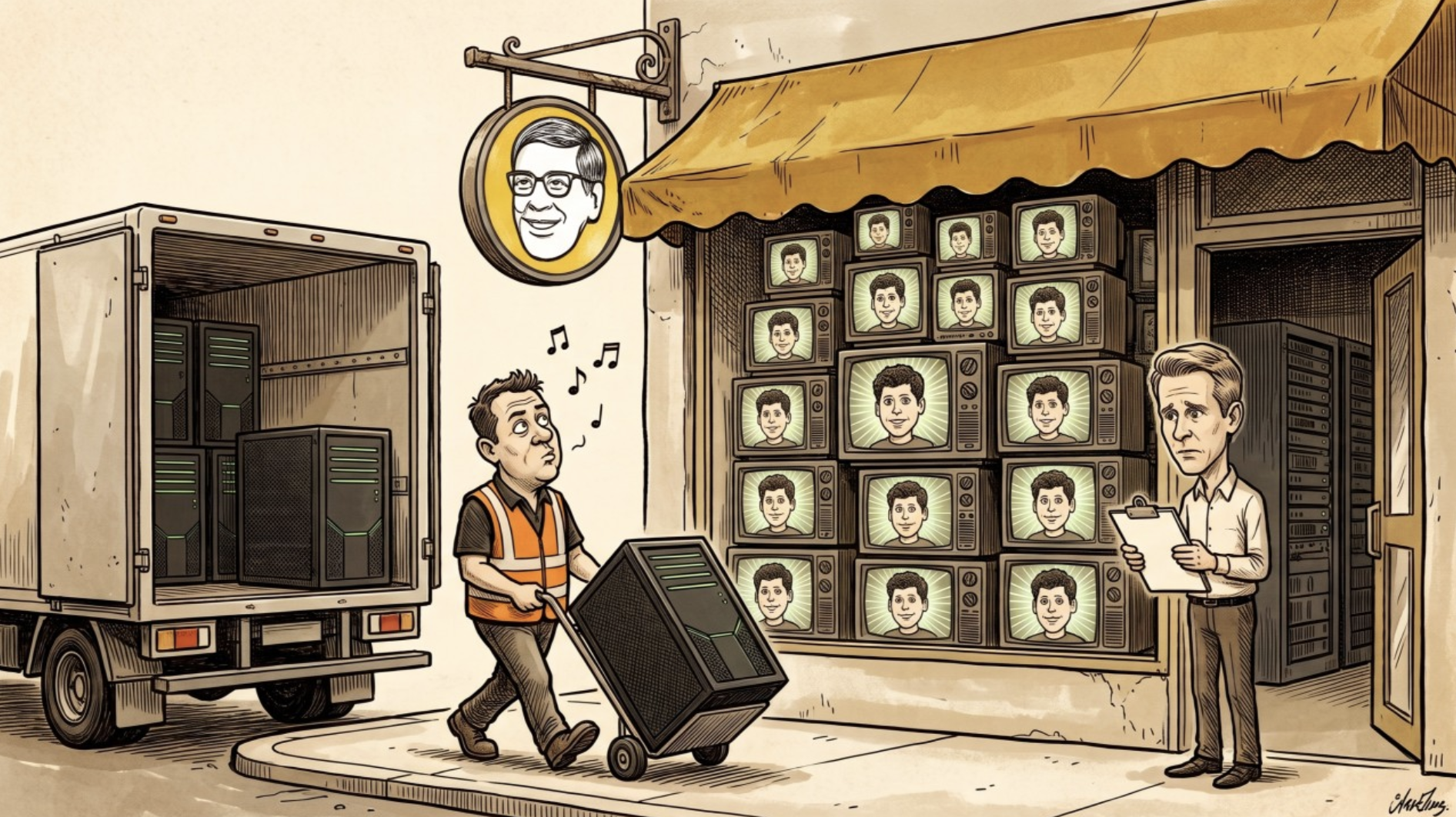
The man who inspired "Money for Nothing" was moving refrigerators around a New York appliance store, grumbling at a wall of televisions, when Mark Knopfler started taking his lines down almost word for word. Sting added a single line, borrowed from one of his own songs, and got paid (his publishers insisted on a co-writing credit). Forty years of royalties. Nobody ever got the delivery man's name.
Author: Matt Vitale