
This week Anthropic made public its prospectus for a proposed Nasdaq listing.
It earned US$16.3 billion in the first half of this year, 80 per cent of it from customers paying for usage "metered in tokens", ie a measure of words.
Among the possibilities it lists for AI is "expert financial and legal advice". In February, days after Anthropic released a legal plugin, Thomson Reuters lost about 16 per cent of its value in a day, RELX 14 per cent and Wolters Kluwer about 13. The AFR says the AI reckoning has arrived for Australia's legal industry. The Chief Justice of the High Court, Stephen Gageler, said in March that "civil law practice will probably be overtaken by artificial intelligence very soon".
Meanwhile, Australia's large law firms have just had one of their best years in a decade. Profit per equity partner is up 74 per cent since 2020, against 51 per cent growth in nominal GDP. The angst the legal profession is feeling is a commercial one, and it's probably with good reason, but what's really at threat is the way lawyers are paid, not lawyers.
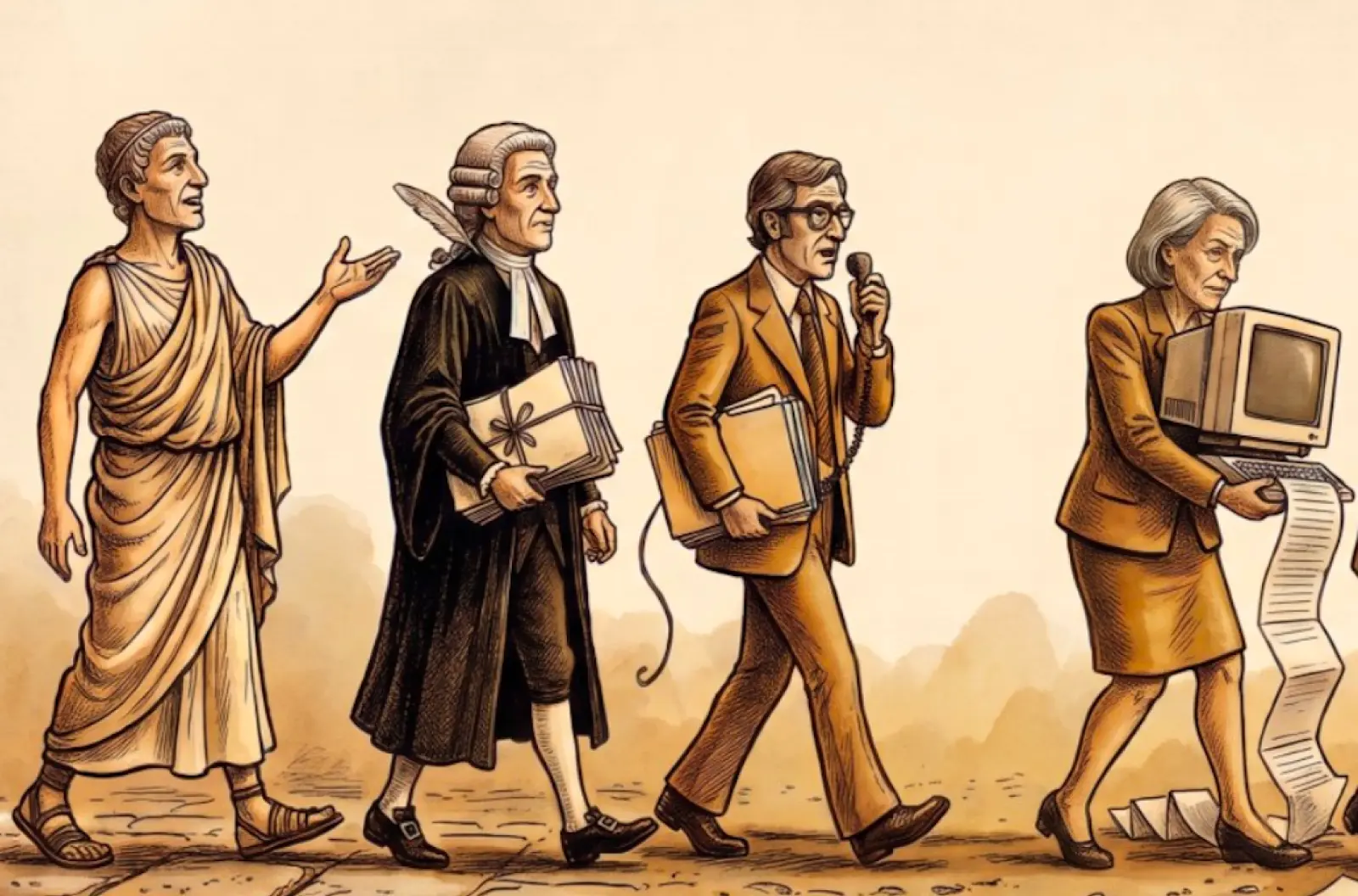
How lawyers got paid
Roman advocates weren't allowed to be paid at all. The lex Cincia of 204 BC forbade taking money or a gift for pleading a case, and Plutarch says Cicero would accept "neither fees nor gift". He was repaid in other ways: more than 20 million sesterces in legacies from friends, by his own count, a loan from a client who was on trial at the time, and votes. In AD 47 the Senate argued about it. One side said fees breed lawsuits: as diseases bring fees to physicians, "so the rot of the forum brings money to advocates". The advocates replied, "Take away the rewards of study and study itself will perish." Claudius capped fees at 10,000 sesterces a case. Roman law settled on paying advocates for their work. A share of the result, which one jurist called "buying the outcome of the lawsuit", was never allowed.
Later, English solicitors were paid by the word: so much per folio of 72 words, drafted, copied or read. The folio always paid for more than copying. In 1654 Chancery's under-clerks admitted that copying money was how an attorney who "spends almost the whole day in advising and directing Clients" got paid. In 1880 the Lord Chancellor, Lord Cairns, told the House of Lords that solicitors' pay "depends, strange to say, very much on the length of those instruments. It is as if physicians were remunerated according to the quantity of medicine they can persuade you to take." He wouldn't shorten deeds without replacing the pay, so from 1883 conveyancing was paid as a percentage of the deal's value.
In 1994 New South Wales abolished most of its scales of costs, and time billing became the default. In 2004 the NSW Chief Justice, Jim Spigelman, said "it is difficult to justify a system in which inefficiency is rewarded with higher remuneration". By 2005 a state review panel found the costing mechanism had "effectively become the product".
Thirty years of trying
Value-based and event pricing have trended in legal industry chatter for as long as I've practised, and I can think of several attempts during my career. In 2014 the Productivity Commission recommended that every state and territory have an online guide to typical legal fees, fixed and events-based fees included, running by the end of 2016. A decade on, none appears to have built one, and in 2023 a study for the Victorian regulator found that comparing prices "is not possible". The hour survived because it kept paying. In a 2019 survey of US firm leaders, two in three said they weren't "feeling enough economic pain" to change. Good results are the comfort, and they're also the problem.
What's different now
AI hasn't made the law free. Law has always been free: anyone can walk into a public library and read the laws of the land, and that's fundamental to democracy and the rule of law. AI makes it usable, and the market is repricing the businesses that sold access to it. The words are cheap now, and we pay the machines by the token, the folio's descendant. Queensland's court scale still allows $26.75 per 100 words of drafting.
What's changed for lawyers is the incentive. The Queensland Law Society says that when a lawyer bills by the hour, the benefit of time saved using AI is "the client's, not the firm's". A firm that adopts AI and keeps billing by the hour shrinks its own invoice. It's dollars.
What the lawyer is for
As a lawyer, my duties to the court sit above my duty to my client. When I say something, I have accountability for it, and accountability that is higher than a self-interest. That's why a court, a counterparty or a lender will accept a lawyer's word, and it's what clients have always really been paying for, whatever the unit.
Anthropic's prospectus makes the same point from the other side. It tells investors its models are used in "high-risk or sensitive contexts", legal among them, and lists failures including models "misrepresenting whether tasks had been completed or verified". It notes that the law of "agency, product liability, and professional negligence" was "developed in the context of human decision-making", and it limits its own liability through disclaimers it concedes "may not be upheld". The vendor sells the words; the lawyer carries the duty.
Which is why the obvious fix is the wrong one. Plenty of clients now ask to pay for the outcome. Two thousand years of law say that's the one thing you can't pay an advocate for: Rome refused it, and the Uniform Law still bans percentage fees. A fee for the matter, priced by what's at stake and the duty carried, is the oldest answer there is.
Better instructions
Lawyers have always complained about poor instructions, and under the hour, poor instructions are billable. Fixed and event pricing stalled because firms couldn't estimate the work. Better instructions are what make it estimable. A client who understands their position before they call is the best thing that can happen to a firm that prices by the event.
Clients are using AI to get there anyway, and on their own it often goes wrong. They get answers from the wrong jurisdiction, they lose privilege (in February a US judge ruled that a defendant's conversations with a public AI tool weren't privileged, because the tool isn't a lawyer), and they send their lawyer pages of AI-drafted mark-up that someone then reads and bills. When nobody with a duty is in the loop, the risk lands somewhere else. In August a dismissed Aldi worker pressed on with an AI-drafted claim that had the wrong date in it, ignored two warnings, and was ordered to pay $1,230 of Aldi's costs.
A safer room
Law firms are investing heavily in AI. Large Australian firms lifted technology spending per lawyer 9.2 per cent last financial year, and the biggest have built private environments for their own lawyers. The next step is to turn those rooms outward. Clients are going to use AI anyway, so give them a confidential space, grounded in the documents their lawyer has shared and supervised by their lawyer, where they can ask every question they like and arrive with better instructions.
The judge in that February case suggested the answer might have been different had the client's lawyer directed the use. No setup guarantees privilege, but a supervised room is a far safer place than a public chatbot. It also extends the lawyer's duty to the place clients are already working. These are good years, and good years are when to invest in it.
Lord Cairns knew it wasn't fair "to take away the length of instruments which fixed their remuneration, and provide nothing in their place". Maybe this is finally the moment that a better bargain is struck between lawyers and the people they serve. We should all care about this.
Author: Matt Vitale