.svg)


Equally urgent and dramatic, or obvious and factual.
On Saturday the chief executive of Anthropic published 3,800 words arguing the industry should slow down. Elon Musk agreed within the hour, in three words. Sam Altman agreed a bit later and said he'd have more to share soon. Demis Hassabis agreed overnight. By Sunday the US President was at his Irish golf resort telling reporters that whoever wins AI, wins.
We're in a hype cycle and it's getting faster. All of these announceables, many of them future-dated, as every actor in this play feels the pressure to keep up, or at least be seen to be keeping up, in a race where, honestly, I've lost track of the destination, the finish line and the point of it all.
Without hopping into the details of the Anthropic employee who resigned the week before citing existential concerns, I too fear an existential crisis. Just not in the way most people in this space are describing it. I think we're on the brink of collective burnout from all of this noise. The whiplash.
AI is going to take my job. No, AI is not going to take my job. It's all about large language models. Actually, it's all about small language models. Open source is the future. Stop, open source should be banned. Government's going to be hands-off. Government's going to be hands-on. Slow down. Speed up. It never ends.
Nothing you can buy
Say a word enough times and it stops being a word. AGI. Existential risk. Critical capability. Sovereign. Slow down. All of them said so often, by so many people, that they've come loose from whatever they used to point at.
Three researchers at Yale and Bologna have just audited the practice itself. They took 24 of the most widely circulated predictions about AGI made since 1950 and asked of each whether it could ever be shown to be false. Nineteen could not: a date attached to a state nobody had defined, nobody could measure, and nobody but the person predicting it could settle. Two were testable. Both were wrong, and both were made in the 1950s. Seventy-six years, and the quality hasn't improved.
Which brings us to the fortnight just gone.
The slowdown essay commits its author to one thing: outside reviewers inside Anthropic's offices, with desks, badges and laptops, at some point in the near future. No date, no threshold, and it sits on his personal website rather than his company's. The same man wrote in 2024 that powerful AI might arrive as early as this year, and his company told the White House the following March it could come by late 2026 or 2027. Neither horizon was withdrawn. They stopped being mentioned.
OpenAI's president told a press call we're in the AGI era, a claim you won't find in any of the company's own documents. Astra's headline score of 99.9 per cent on a reasoning benchmark falls to 62.7 when the benchmark's own team runs it on their standard harness. And Canberra released draft legislation on a digital duty of care with the list of harms left open for the minister to extend later. Asked on Sunday whether Australia wanted the slowdown, that minister replied, "Well, AGI is here, isn't it?"
Not one of those is something you can buy, sign, audit or rely on.
You can't write a contract clause against a sound. You can't audit against rules nobody has finished writing, and you shouldn't lean too hard on a benchmark that moves 37 points depending on how it's run. A board that read every announcement this fortnight has been handed nothing it can act on.
The two nobody was arguing about
Two things were real and are yours to deal with, and neither was a claim about the future.
Astra shipped, and reached Enterprise accounts inside a week, switched off by default. OpenAI classifies it as Critical for cybersecurity capability under its own framework, meaning it can find unknown security flaws and work out how to exploit them without a person guiding each step. That capability didn't ship with it. It sits behind an approval programme, and the production model is meant to refuse the work.
And from 10 December, if your business uses personal information in a computer program that makes or helps make decisions significantly affecting people, your privacy policy has to say what information it uses and what kinds of decisions it makes. That's law. It sits with you, not your vendor, and it covers the decisions your software merely assists with.
Neither of those trended. The two things that actually change what somebody does on Monday were the two nobody was arguing about.
What a shipped thing looks like
A fortnight ago Meta published how it built an internal AI that learns from its own experts. Not a vision, the build. Positions live in files, reasoning steps live separately so a bad procedure never gets confused with a bad fact, and every improvement arrives as a text edit an expert approves in about thirty seconds.
Six weeks, three sprints, one part of the business. They kept ordinary search for everything else and didn't try to replace the expert.
That's the standard the rest of the fortnight fails, and honestly it's a low bar. Somebody wrote down what they built, what it cost and what it doesn't do.
We're all going to die. That was true a fortnight ago and it'll be true a fortnight from now. I've leaned harder on a spiritual frame these last few years. Act in the present. Know what you control and what you don't. Be sanguine about what today actually asks of you. Take a deep breath, exhale, pause, and act.
The future never exists. It's only imagined.
One more thing
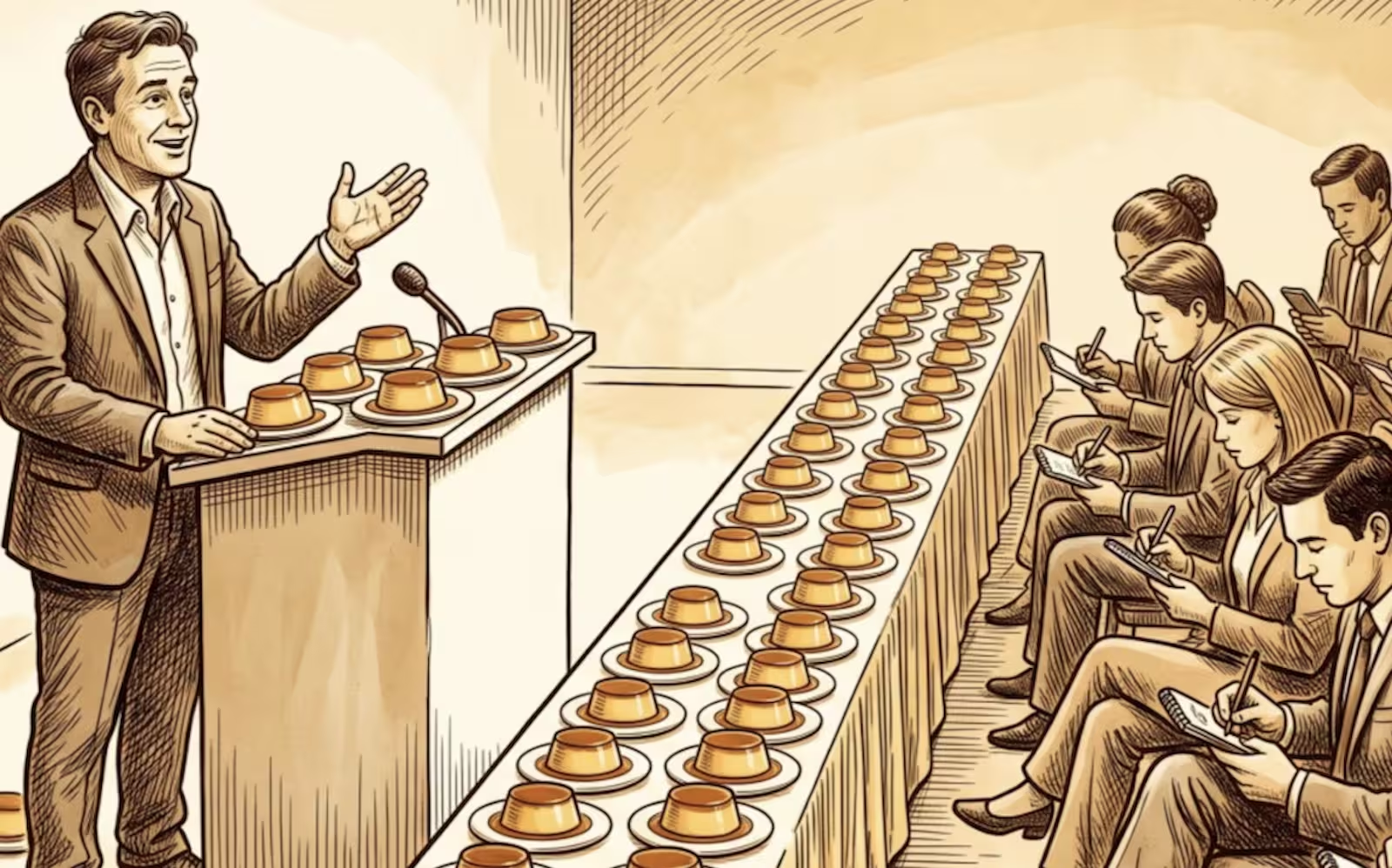
There's an episode of Ted Lasso from 2020 where Ted, mid-conversation about a player he's about to lose, says the word "plan" one time too many. Then he says it again. And again. It stops working on him. He wanders off into whether it rhymes with flan, and whether he even likes flan, and by then it isn't a word at all. Just a noise a mouth makes.
He asks what it's called when a word becomes a sound. "Semantic satiation," says Coach Beard.
Author: Matt Vitale


.avif)