.svg)

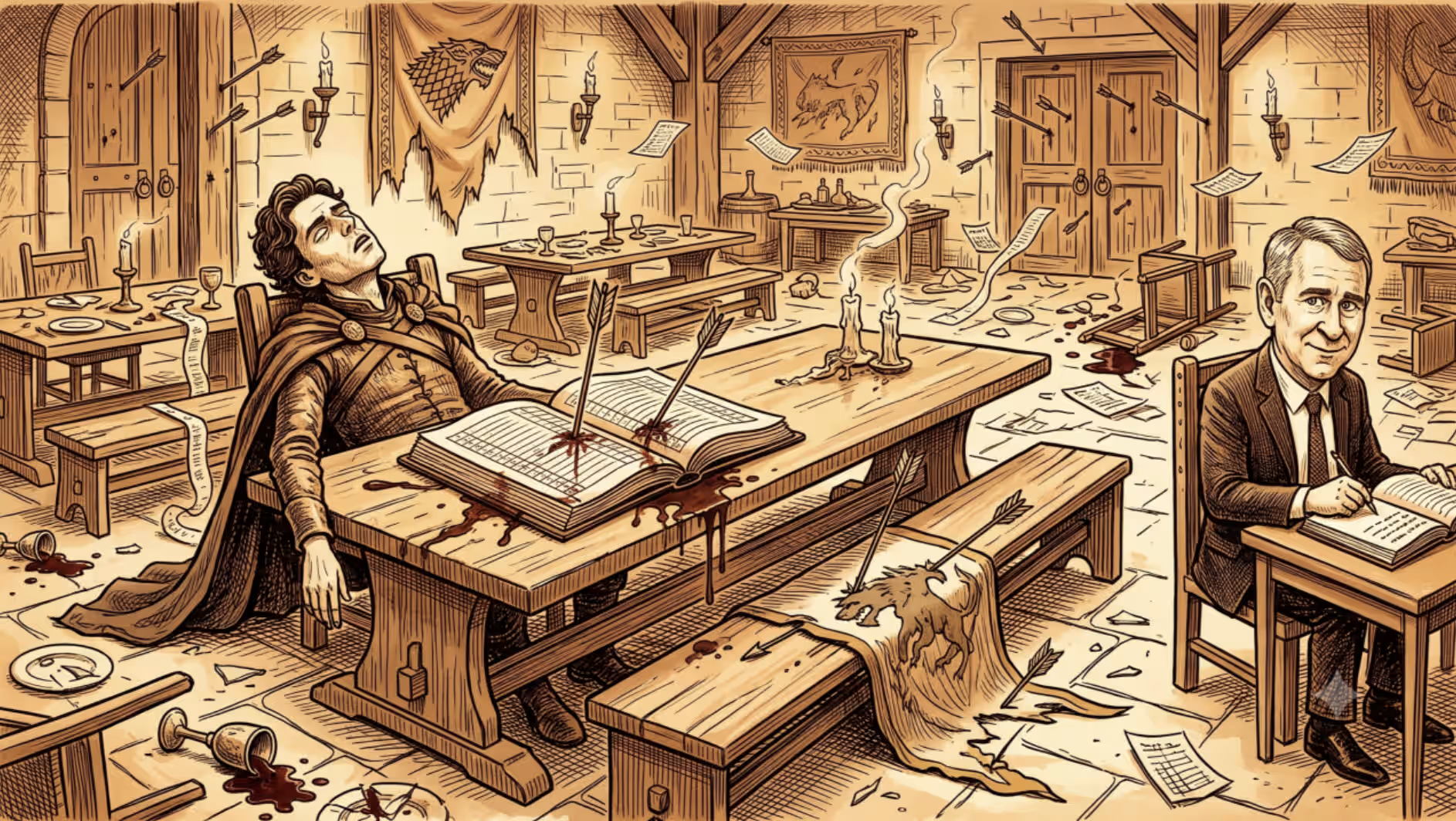

Leopold Aschenbrenner is 24. A month ago he was running the hottest fund on Wall Street, up more than 1,000 per cent in two years on a single idea: AI changes everything.
Ken Griffin is 57 and runs Citadel, which is who the biggest investors call when everything must be sold by Friday. Last week, Citadel called him.
Aschenbrenner's fund, Situational Awareness, lost roughly 67 per cent in July. It had borrowed heavily to enlarge its bets, reportedly up to four times its own money. When AI and chip stocks reversed hard, the banks that lent the money wanted it back. By Thursday, what the FT and Reuters describe as his entire public portfolio, about US$16 billion, belonged to Griffin's Citadel. The week was a sorting: buyers went line by line through the AI trade and paid full price only where the revenue was real.
Knowledge is knowing that a tomato is a fruit; wisdom is not putting it in a fruit salad. July tested the AI trade on the difference.
The young wolf
Aschenbrenner left OpenAI and wrote Situational Awareness in 2024, an essay on how fast AI was coming. The essay made him famous, and investors handed him billions under rules that, the New York Times reports, set no limit on how much he could stake on one bet or how much he could borrow. By June the fund's own letter had it up 439 per cent after fees for the year. His biggest holding, the memory maker SanDisk, was up 269 per cent on the AFR's numbers. He is brilliant, and July did not change that.
Then the trade turned. AI and chip stocks fell hard through July, the borrowed money turned a bad month into a forced sale, and the banks that had lent it began calling it back, the margin calls, from Goldman Sachs, JPMorgan and Bank of America. The fund tried everything else first. A letter dated 24 July invited investors to put more in, calling it "a particularly good time to add funds". Then, Bloomberg reports, Citadel heard about the trouble and called. The deal was done overnight: the portfolio, reportedly at about 10 per cent below its market value. The letter that followed said, "We let you down this month."
Two numbers are both true, and the second keeps getting left out: down 67 per cent in a month, still up about 80 per cent for the year. The obituaries are running ahead of the arithmetic. The fund kept its private holdings, reportedly including a stake in Anthropic put at about US$5 billion, and it now runs without borrowed money.
Griffin did not outsmart anyone, and did not need to. Citadel's business is having a price ready when somebody has to sell everything at once; the discount is the fee. Once the forced selling stopped, the same stocks bounced, on the AFR's numbers: SanDisk up 26 per cent, CoreWeave 21, the Australian-founded Iren 30. July proved something duller than the essay being wrong. The idea needed years to prove out; the loans could be called in a day. The shorter clock got the casting vote.
The wedding was already set: he and Avital Balwit, chief of staff to Anthropic chief executive Dario Amodei, the first weekend of August, in Carmel. The banks were calling in the loans while the guests, by Fortune's account, were arriving on the Thursday the portfolio was sold; the celebration, the San Francisco Standard reported, would open with a colloquium of panels and breakouts before the vows at a Tuscan-style villa. The coverage records all of it politely, one fact at a time. Weeks like that are not lived one fact at a time. The wedding kept its date.
If you buy AI for an organisation rather than trade it, ask what the banks asked: can this survive a bad month? The vendor question for 2026 is what the balance sheet underneath the contract can survive.
The sort
The same five days handed out the market's two extremes. Microsoft reported its Azure cloud growing 43 per cent and added about US$450 billion in a day, the largest one-day gain by any company in US sharemarket history. Meta fell about 8 per cent the same session, its AI spending swallowing nearly all the cash the business generates. SK Hynix reported the best quarter in its history and still missed expectations. The trade press has July tracking as the worst calendar month Korea's main share index, the KOSPI, has ever had. A record quarter was no protection that week.
The Australian line in the ledger is NextDC. In March it tried to borrow $500 million from bond investors and walked away, per the AFR, because the interest rate on offer was too painful. In July, banks signed A$2.3 billion in new loans for the same company, taking its total facilities to as much as A$8.7 billion, at rates no worse than before. What changed in between sits in the contract register: customer commitments up 60 per cent to 667 megawatts, 250 of them at a single Sydney site.
The same test works on any AI vendor list, because what a vendor pays to borrow reaches you eventually, in renewal pricing and in how much they still want your business when money tightens. Read the order book before the manifesto.
The winner's warning
The strangest advice of the week came from the man who won it. On the Sunday, four days before Microsoft's US$450 billion Thursday, Satya Nadella went on CNN and told firms to keep the record of how their people use AI. Route it through systems the firm controls, he argued, and use it, in time, to train AI models of their own. "Any firm that doesn't have this control, I will claim will not remain a firm because you've essentially outsourced your thinking." Keep the context and the memory apart from the model, so that "any one model can go away, and you can still continue to be in control of your own destiny." Azure rents the computers those models run on, so he is selling something too. The advice survives that.
Put his Sunday next to the fund's Thursday. The week's biggest winner, US$450 billion richer from renting out intelligence by the metered token, says the thing that keeps a firm a firm is the record of its own thinking. Held where no vendor's balance sheet can reach it, accumulating on your clock and nobody else's. Intelligence is now sold by the token. Wisdom is still built from your own record.
One more thing
On 2 June 2013, HBO aired the Game of Thrones episode the internet came to know as the Red Wedding. Within a day a new genre appeared on YouTube: people who had read the books filming friends and family who had not, as the scene arrived. One compilation collected 4.6 million views in two days. Four days after the broadcast, George R.R. Martin sat on Conan and watched the reaction videos himself. "Now you know why your nerdy friends were really depressed 13 years ago," he said. He had built the massacre from two real events in Scottish history, the Black Dinner of 1440 and the Massacre of Glencoe in 1692. The book had been on the shelves since 2000.
Author: Matt Vitale


.avif)


.avif)
.avif)