.svg)


Fifty companies signed a letter last week saying the real insanity is treating open models as contraband.
Jensen Huang broke a lifetime of silence on X to carry it, and over 60 million people read the post. He is right. But there's a bigger madness in plain sight no one is talking about. It's the record. Every prompt, correction and abandoned draft teaches an AI how you think, and that accumulation now sits wherever the provider keeps it, governed by nothing. The industry is at war over the commoditising layer while the compounding one goes unclaimed. Australia is the one country that already owns the legal machinery to claim it. The Consumer Data Right can designate a sector, accredit who receives the data and set the standard it travels in. Point it at consumer AI assistants. Give people the right to take their context with them. This is competition law, not privacy law. Privacy asks how your data may be used. Portability asks whether you can leave.
The asset nobody has priced
A US court gave final approval last Monday to Anthropic's US$1.5 billion settlement over pirated books. Training on them was held fair use on the facts. Keeping a permanent library of stolen ones was not. That heist has a number, a courtroom and a queue of lawyers.
The second one is still running, and it has no name.
Your assistant knows which client you dread. It knows the draft you abandoned and why, how you argue when you are losing, what you told it to leave out of the email. None of that was scraped. You handed it over gladly, a few hundred words at a time.
So theft is the wrong frame. This is a switching cost, and it compounds quietly. Give it three years and you will stop comparing rivals altogether. A new assistant would not know your clients, your projects, or the reasoning behind last year's decisions. It arrives as a brilliant stranger, and you pay to train it. Madness.
Albanese used his AI speech to say that not everything produced in Australia is "up for grabs". He was talking about artists. Nobody is asking the same question about what is produced about you. The government's five-part safety agenda shields the citizen and hands them nothing they can carry away.
Portability works before the accumulation entrenches. Nothing here claws back the past. It changes who owns what comes next.
One layer down
That letter started smaller than it finished. Twenty-five signatures on Friday, fifty within a day, Google and OpenAI arriving late. At time of writing, Anthropic has not signed. The one lab standing apart is the one whose model was allegedly distilled.
Because that is what the letter is answering. The White House's science adviser says Moonshot built Kimi K3 by distilling Anthropic's Fable 5. The Treasury Secretary floated sanctions. In June, Washington ordered Anthropic to cut foreign access to its two most capable models, then eased it. And yesterday, mid-argument, the K3 weights landed anyway.
That June order is the fact Australia should sit with. Rented intelligence can be switched off from another country's capital. Context built on top of it cannot be, provided it sits somewhere you control.
Hugging Face proved the narrow version of that in July. Breached by an autonomous agent, it tried to analyse the attack using frontier models behind commercial APIs and was refused, because a guardrail cannot tell an incident responder from an attacker. It ran the forensics on an open Chinese model on its own hardware instead, reconstructed 17,000 events, and kept every stolen credential inside its own building. Yesterday Nvidia turned that lesson into a second letter, an open-security alliance thirty-odd companies deep. Anthropic is not in that one either.
Two coalitions, thousands of words, all of it about who may hold the model. Unsurprisingly, neither says a word about the record it keeps about you.
The machinery asleep in Canberra
Britain got to open banking first, imposed on its largest banks as a competition remedy. Australia generalised it across the economy, and Britain only legislated its own cross-sector version last year.
I admit this proposal has a glass jaw. Uptake was thin, the compliance bill was heavy, and Canberra tipped another $88.8 million into running the regime before deciding to reset it. But open banking asked people to value data they had never once experienced as a product. Nobody feels their transaction history. Everybody feels an assistant that knows them.
Others are circling. Stanford researchers have prototyped a Human Context Protocol, a user-governed layer that travels between systems with scoped, revocable access. Europe's portability rules reach the data you supplied, not the inferences built on top of it. India accredited consent intermediaries years ago under DEPA. None of them start where Australia starts, with the powers already legislated and aimed at the wrong sector.
Run it at three scales. A person renting commodity intelligence on top of a record they own. An organisation bringing models to its data instead of shipping its data to the models, which is what Hugging Face did under fire. A nation setting terms on the infrastructure. Canberra has legislated for exactly one.
Intelligence has commoditised. The path to deploying it has not, which is the gap New Dialogue was built to close for organisations. It is the identical gap for one person carrying three years of history around inside somebody else's product.
The speech settled who controls the racks. Albanese said not everything produced in Australia is up for grabs. The record produced about you still is.
One more thing
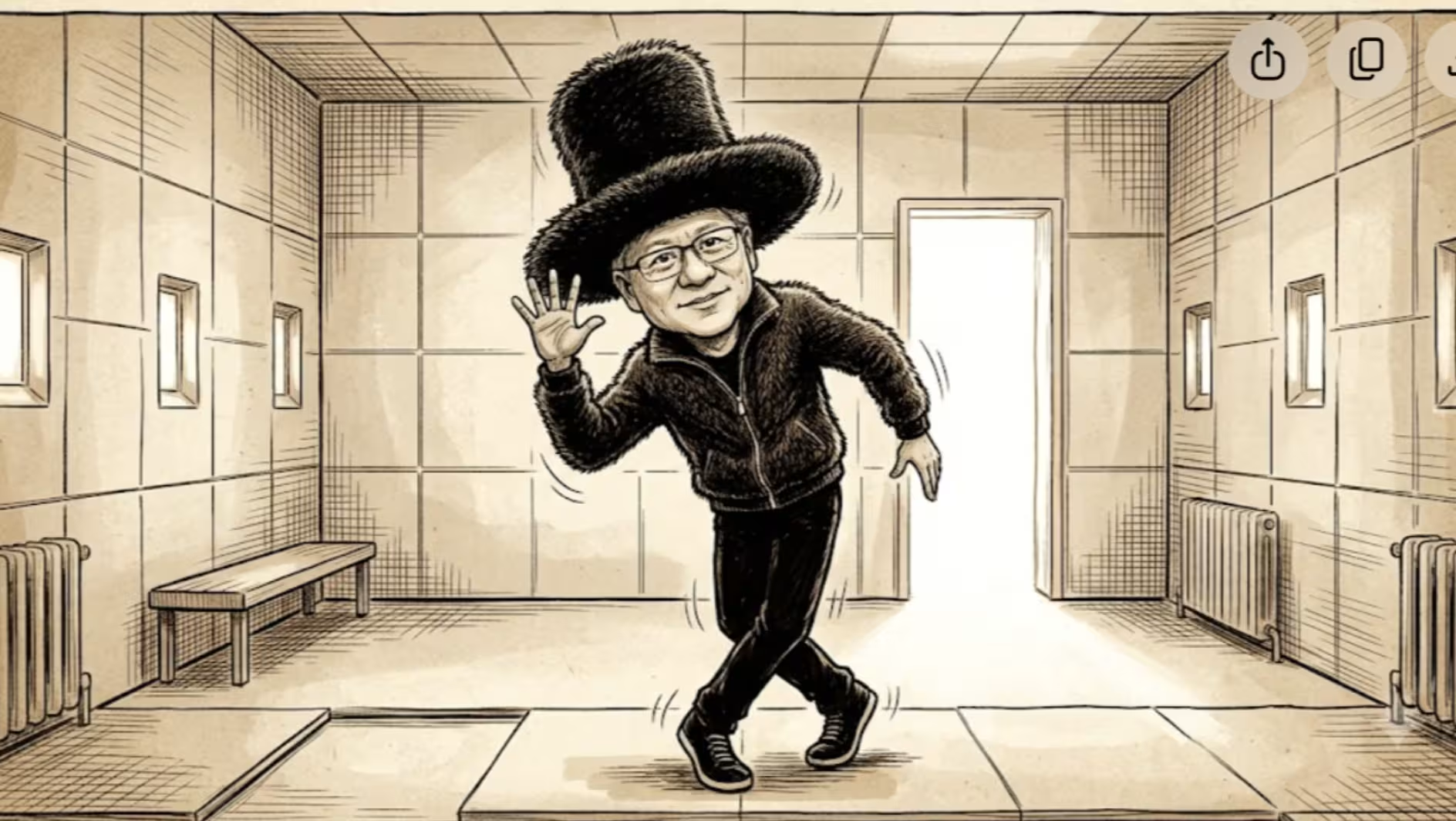
Beefeater put Jay Kay back in the room on Thursday, thirty years after Virtual Insanity. The anniversary version was built the old way, nine physical rooms, no CGI and no AI, choreographed by Jay Kay himself. "As a prediction of the future," he said of the song this week, "it wasn't too far off." The original trick was that he never actually went anywhere. He glided, the walls slid past, and he finished exactly where he started. The Space Cowboy getting sober curious with Beefeater 0.0, how times have changed!
Author: Matt Vitale